In this article
On an October or November night, look towards the eastern sky at about 9 or 10 pm and you may notice a small, misty knot of stars huddled together. Many people have seen it without knowing what it is. It is the Pleiades, and it is a perfect example of a star cluster.
Because Sri Lanka lies close to the equator, we can enjoy the finest clusters of both the northern and southern skies. In this article we look at what star clusters are, the two main kinds, and the best ones to see from Sri Lanka with your eyes or a pair of binoculars.
Table of Contents
What is a star cluster?
Stars are not born alone. When a cloud of gas and dust (a nebula) collapses, dozens or thousands of stars form at about the same time. The stars in a cluster are therefore siblings: the same age and made of the same material.
That makes clusters extremely useful to astronomers. By comparing stars of the same age and distance but different masses, they can see exactly how a star’s life depends on its mass. Our article on types of stars explains more.
Open clusters and globular clusters
| Open cluster | Globular cluster | |
|---|---|---|
| Number of stars | usually about 50 to 1,000 | hundreds of thousands, sometimes millions |
| Shape | loose and irregular | a tightly packed ball |
| Diameter | usually under 30 light-years | about 50 to 450 light-years |
| Age | young (typically a few hundred million years or less) | very old (billions of years) |
| Location | the galaxy’s disk and spiral arms | the spherical halo around the galaxy |
| Number in the Milky Way | thousands | about 150 |
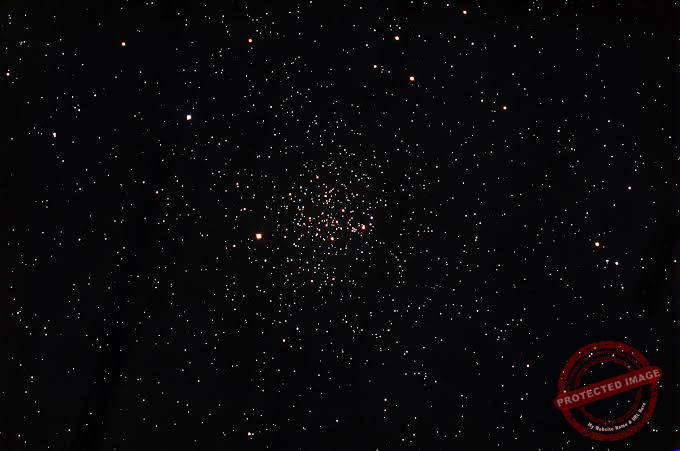
The stars of an open cluster are only loosely held together by gravity and drift apart over time. Astronomers think our own Sun was born in such a cluster, and its siblings are now scattered across the galaxy.
The Pleiades: the Seven Sisters
The Pleiades, or M45, in Taurus is the most famous star cluster in the world, also called the Seven Sisters. About 444 light-years away, it contains more than a thousand stars, yet only six or seven are visible to the naked eye; people with sharp eyes under a dark sky may count a dozen or so.

In astronomical terms the cluster is young, estimated at about 100 million years old, which means its stars were born while dinosaurs walked the Earth. Through a telescope or camera, a blue haze appears around the stars: dust in the region the cluster is passing through, reflecting their light.
From Sri Lanka: in late October it rises in the east at about 7–7.30 pm. From December to February it is well placed from dusk onward. It looks best through binoculars.
The Hyades: the nearest cluster
A little east of the Pleiades, a V-shaped group of stars surrounds the bright orange-red star Aldebaran. This is the Hyades, about 153 light-years away and the nearest star cluster to the Sun. It is roughly 600–700 million years old.
Surprisingly, Aldebaran is not a member. It lies only about 65 light-years away, between us and the cluster, and simply happens to line up with it. In 2021, data from ESA’s Gaia satellite showed thousands of stars that have escaped from the Hyades, stretched into two “tails” thousands of light-years long. The cluster is slowly dissolving.
The Beehive (M44)
The Beehive, or Praesepe, in Cancer, is about 600 light-years away and has roughly 1,000 stars. To the naked eye it is a faint blur. Around 1609–10, Galileo turned his telescope on it and showed that it was a group of more than 40 stars. Binoculars show about 20.
From Sri Lanka: it is well placed in the evening from February to April, with March the best month. Choose a dark, moonless night.
Omega Centauri: Sri Lanka’s special advantage
Much of Europe and North America never sees it, but from Sri Lanka Omega Centauri (NGC 5139) is easy to find. It is the largest and brightest globular cluster in our galaxy: about 17,700 light-years away, with some 10 million stars, and about 10 times as massive as other large globular clusters.
A study published in Nature on 10 July 2024 used more than 500 Hubble images spanning 20 years to find seven fast-moving stars near the cluster’s centre. The best explanation for their speeds is a black hole of at least 8,200 solar masses at the core. Such “intermediate-mass” black holes are very rare, and this one is not yet fully confirmed.
Under a dark rural sky, Omega Centauri looks like a fuzzy star almost as large as the full Moon. From Sri Lanka: it is visible in the southern sky at night from April to July, climbing to about 35 degrees above the horizon. It reaches that highest point around midnight in mid-April, around 10 pm in mid-May and around 8 pm in mid-June. Through binoculars it looks like a glowing ball of cotton.
The Jewel Box near the Southern Cross
In Crux, the Southern Cross, close to the star at the cross’s left arm, lies the Jewel Box (NGC 4755). It is about 6,400 light-years away and only about 16 million years old. In the 1830s, the English astronomer John Herschel saw its blue and orange stars and likened it to a piece of jewellery, giving it its name.
From Sri Lanka: from April to June (and late at night in March), the Southern Cross appears low in the southern evening sky. The Jewel Box is only about 20 degrees above the horizon, so you need a clear view to the south. Use binoculars.
M7: Ptolemy’s Cluster
Near the tip of the scorpion’s tail in Scorpius lies M7, called Ptolemy’s Cluster because the Greek astronomer Ptolemy recorded it in AD 130. About 980 light-years away, with around 80 stars, it is visible to the naked eye. From Sri Lanka: look for it on July and August evenings, set against the brightest part of the Milky Way.
Tips for viewing star clusters
- Binoculars are ideal: ordinary 7×50 or 10×50 binoculars show every cluster in this article beautifully. You do not need a big telescope.
- Find a dark sky: get away from city lights. See our guide to stargazing in Sri Lanka for good places.
- Avoid the Moon: nights near new moon are best.
- Let your eyes adapt: allow 20–30 minutes in the dark. Looking slightly to one side (averted vision) helps you see faint clusters.
- Learn the constellations: once you know Taurus, Scorpius and Crux, clusters are easy to find. Our constellations guide will help.
Next time you are under a dark sky, look at the Pleiades and remember that you are looking at a family of stars born in the age of the dinosaurs. And when you find Omega Centauri, you are looking at 10 million stars, and perhaps a hidden black hole.
Sources
- Messier 45 (The Pleiades) — NASA Hubble Messier Catalog
- Meet the Pleiades, the Seven Sisters — Sky & Telescope
- Is the nearest star cluster to the Sun being destroyed? — ESA Gaia
- Messier 44 (The Beehive Cluster) — NASA Hubble Messier Catalog
- Hubble finds evidence for rare black hole in Omega Centauri (heic2409) — ESA/Hubble
- Opening up a colourful cosmic jewel box (eso0940) — ESO
- Messier 7 (Ptolemy’s Cluster) — NASA Hubble Messier Catalog
- Star Clusters — OpenStax Astronomy 2e
How much do you remember?
1. According to the article, how far away is the Pleiades?
The article states that the Pleiades is about 444 light-years away.
2. What does the article say about the stars in an open cluster?
The article says open cluster stars are only loosely held together by gravity and drift apart over time.
3. Why is Omega Centauri considered special for viewers in Sri Lanka?
The article notes that much of Europe and North America never sees Omega Centauri, but from Sri Lanka it is easy to find.
