In this article
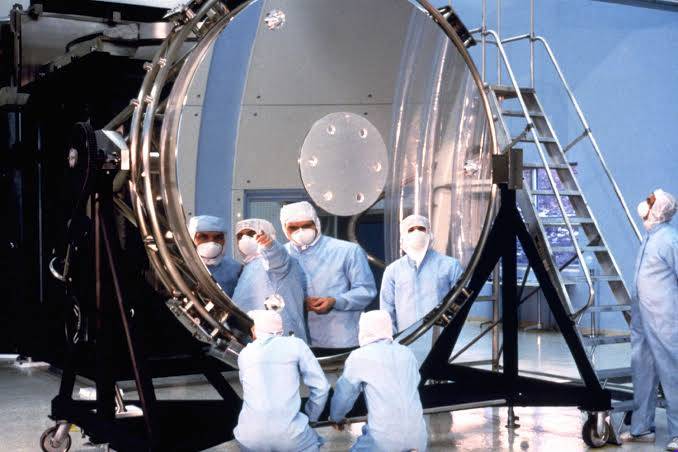
On 24 April 1990 the Hubble Space Telescope went into space billed as the best eye humanity had ever built: about $1.5 billion and years of waiting. When the first images came down, scientists’ faces fell. Stars looked not like sharp points but like smudges inside a foggy halo. The problem was the 2.4 m primary mirror, polished to the wrong shape. The error was a tiny fraction of the width of a human hair, but that was enough.
How the problem showed up
About four weeks after launch, the first-light image would not focus sharply. For a while engineers thought it was a small adjustment. NASA’s Ed Weiler later admitted the team was “in denial” from May until about early June 1990.
In late June Hubble failed a focus test, and on 27 June 1990 NASA announced the telescope suffered from spherical aberration. It was designed to concentrate about 70% of a star’s light into a small circle; it managed only 10–15%.
What is spherical aberration?
In a good telescope mirror, light hitting the centre and light hitting the edge come to focus at exactly the same point, which demands an extremely precise shape. Hubble’s mirror was slightly too flat towards its outer edge, by only about 2 microns (two thousandths of a millimetre). Light from the edge therefore focused a little further away than light from the centre, producing the blurry halo around every star.
The surprising part: the mirror was beautifully smooth. It was made very precisely, to the wrong shape.
The fault was in the “null corrector”
The mirror was made by Perkin-Elmer. To check its shape during polishing, they used a reflective null corrector, a set of mirrors and a lens that acts like an optical ruler: when the mirror has the right shape, the test pattern seen through it shows straight lines.
The investigation board led by JPL director Lew Allen reported in November 1990 that one lens in this device sat about 1.3 mm too far from where it should have been. Its spacing was set with a laser that should have reflected off the end of a measuring rod. But part of the non-reflective coating around it had broken away, so the laser reflected off the wrong surface, and the lens was set using that wrong measurement.
The mirror was then polished for years to match this faulty ruler. It matched perfectly. The ruler was wrong.
Warnings seen, then set aside
This was the report’s biggest lesson. Two other Perkin-Elmer test devices, a refractive null corrector and an inverse null corrector, did show spherical aberration. Their results were dismissed because they were considered less precise and “uncertified”. The board later found they had in fact been accurate.
No full end-to-end optical test of the assembled telescope was done before launch. Some have pointed out that Kodak-Itek, a rival bidder, had proposed two independent checks that would likely have caught the error.
A pair of “glasses” for Hubble
Here is the clever part. The error could be measured exactly, and just as an optician needs your exact prescription to make glasses, knowing Hubble’s error precisely meant correcting optics could be designed.
- COSTAR (Corrective Optics Space Telescope Axial Replacement), built by Ball Aerospace, carried 10 small mirrors (five pairs) on arms that swung out like drawers. They fed corrected light to the Faint Object Camera and two spectrographs. To make room, the High Speed Photometer was removed. It cost about $50 million.
- WFPC2 (Wide Field and Planetary Camera 2) replaced Hubble’s main camera, with the correction built inside. Weiler regarded it as the real fix.
December 1993: surgery in orbit
On 2 December 1993 the shuttle Endeavour launched with seven astronauts on STS-61, Hubble’s first servicing mission. It made five spacewalks, a record at the time, totalling 35 hours 28 minutes.
- Story Musgrave and Jeffrey Hoffman replaced gyroscopes and later installed WFPC2.
- Kathryn Thornton and Tom Akers fitted a new solar array and swapped the High Speed Photometer for COSTAR.
- ESA astronaut Claude Nicollier operated the robotic arm.
The shuttle landed on 13 December 1993. Within a month, new images showed Hubble had reached its intended sharpness. US Senator Barbara Mikulski declared “the trouble with Hubble is over.” For the famous images that followed, see our article on deep field images.
The glasses come home
Later instruments had the correction built in, so COSTAR gradually became unnecessary. It was removed on the final servicing mission in 2009 and brought back to Earth, and it is now displayed at the Smithsonian National Air and Space Museum in Washington, DC. Hubble’s full story is in our Hubble Space Telescope article.
The lesson of Hubble’s mirror: test your measuring tools too, and think twice before dismissing a warning from an independent method as “less precise”. Engineers building newer telescopes such as James Webb still remember it.
Sources
- The Hubble Space Telescope Optical Systems Failure Report (Allen Report, Nov 1990)
- NASA History: 30 Years Ago, STS-61, the First Hubble Servicing Mission
- Smithsonian NASM: Corrective Optics Space Telescope Axial Replacement (COSTAR)
- Spaceflight Now: Fixing Hubble's blurry vision (2015)
- Space.com: 30 years ago, astronauts saved the Hubble Space Telescope
- BBC Sky at Night: What was wrong with Hubble's mirror, and how was it fixed?
Spotted a mistake in this article?