In this article
On 23 September 1999, the team in a NASA JPL control room in California was waiting for one signal. After more than nine months in space, Mars Climate Orbiter had slipped behind Mars and was due to reappear. The signal never came. Within days the team found the cause, and it was not a broken machine. One team had supplied numbers in pounds, and the other had used them as if they were in newtons.
What was the spacecraft for?
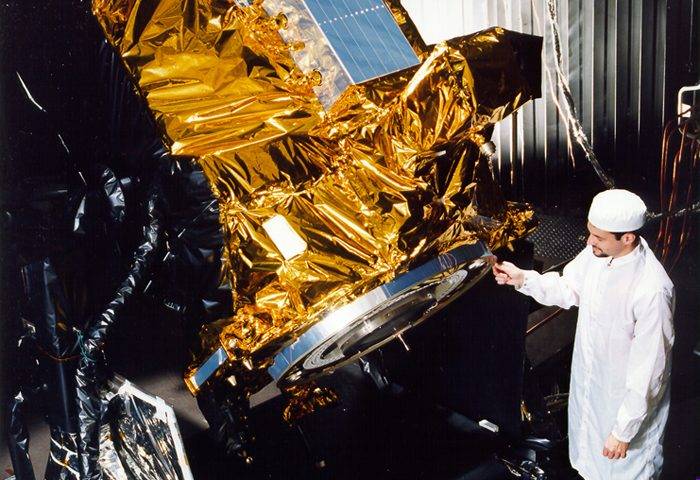
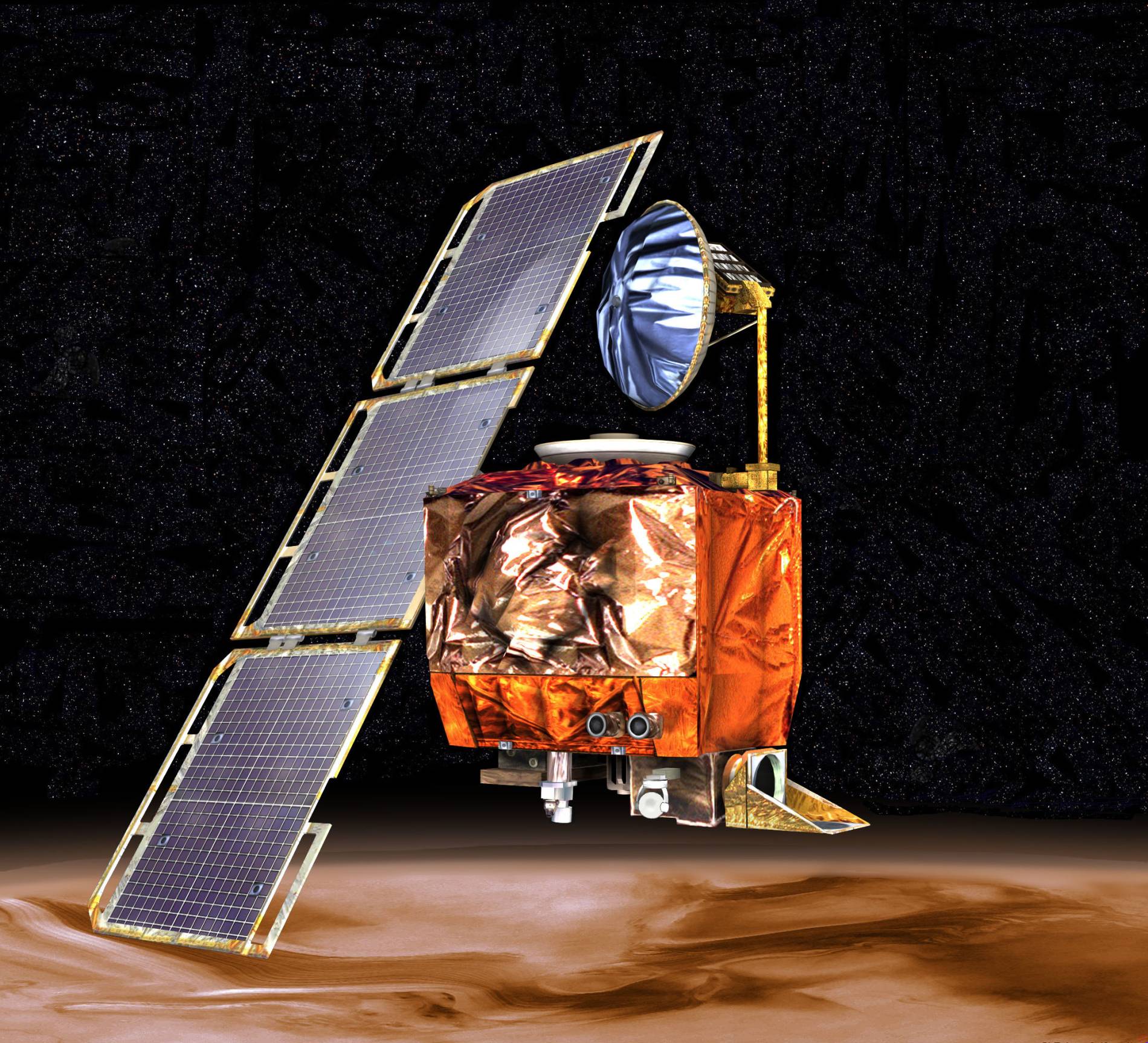
Mars Climate Orbiter was launched on a Delta II rocket from Cape Canaveral, Florida, on 11 December 1998. Its job was to study the weather and climate of Mars: dust, water vapour and clouds in the atmosphere. It was also meant to relay radio signals for the Mars Polar Lander that followed it. Both were part of NASA’s “Mars Surveyor ’98” programme.
The work was split like this:
- Lockheed Martin Astronautics in Denver, Colorado, built the spacecraft and operated it day to day.
- JPL in California did the navigation: working out exactly where the spacecraft was and where it was heading.
The two sides exchanged data through computer files. That is where the trouble began.
Tiny pushes, a big mistake
In space, the gentle pressure of sunlight slowly tries to turn a spacecraft. Reaction wheels inside the craft counter this. When the wheels spin up too much, small thrusters fire to unload them, a manoeuvre called angular momentum desaturation (AMD).
Each firing gives the spacecraft’s path a tiny nudge, and the navigators had to know how big each nudge was. That data came from Lockheed Martin ground software called SM_FORCES (“small forces”). The agreed Software Interface Specification said the values must be in metric newton-seconds (N·s). The software produced them in pound-force seconds (lbf·s).
One lbf·s is about 4.45 N·s, so every nudge the navigation software received was 4.45 times too small. One nudge hardly mattered, but over months the small errors piled up and dragged the trajectory lower.
The warnings were there
The investigation later found several early signs:
- For the first four months of cruise, the AMD files were not used at all because of format errors. Navigators relied on emails from Denver.
- Correct files arrived in April 1999, and within a week they showed odd results.
- The spacecraft had a single, one-sided solar array, so sunlight twisted it more. Desaturation firings happened 10 to 14 times more often than the navigators expected, so the error grew quickly.
- Solutions using only Doppler data put the spacecraft closer to Mars, but the mismatch was never formally reported or resolved.
A last-chance course correction, TCM-5, was possible, but no plans, tests or decision rules had been prepared for it, so it was never carried out.
The final hours
The plan was to pass about 226 km above Mars and fire the engine to enter orbit. In the final week, estimates of that altitude fell to 150–170 km, and data about an hour before the burn suggested as low as 110 km. The minimum survivable altitude was about 80 km.
Later reconstruction put the actual pass at about 57 km, roughly 170 km lower than planned. At that height the spacecraft is thought to have been destroyed by atmospheric friction, or to have skipped through the atmosphere into an orbit around the Sun. Either way, after the last signal at 09:04:52 UTC as it went behind Mars, contact was lost for good.
Not one person’s mistake
On 29 September 1999 the team found the “small forces” values were low by a factor of 4.45, and JPL announced it the next day. NASA’s Edward Weiler said the problem was not the error itself but the failure of systems engineering to catch it.
The Mishap Investigation Board report of 10 November 1999 listed eight contributing causes besides the root cause, including:
- The ground software was not properly checked against its specification.
- The navigation team was unfamiliar with the spacecraft, understaffed and undertrained.
- Communication between Denver and California was poor; concerns stayed in emails.
- Systems engineering did not manage the handover from development to operations.
What NASA changed
On 3 December 1999, Mars Polar Lander was also lost during landing, for a different reason, covered in our article on why Mars missions fail. NASA then set up an independent team led by Thomas Young. Its report of 14 March 2000 said the “faster, better, cheaper” policy could work but had never been clearly defined, and that Mars ’98 had been underfunded by at least 30%.
Changes that followed included:
- A dedicated Mars Program Office at JPL and a single responsible contact at NASA Headquarters.
- Project managers responsible for the whole mission, including operations, not just the build.
- Contractors required to report risks and departures from good practice formally.
- Senior managers making clear: “if not ready, do not launch.”
The value of a small label
Unit mix-ups do not happen because people are foolish. When a number moves from one system to another without its unit clearly attached, the receiver assumes the unit they are used to. A factor of 4.45 is large, but because each nudge was tiny, nobody clearly saw it. Mars Climate Orbiter is now taught in engineering classes worldwide. For more NASA errors, see our article on NASA’s mistakes.
Sources
- NASA Mars Climate Orbiter Mishap Investigation Board Phase I Report (10 Nov 1999), NASA LLIS
- Mars Climate Orbiter Mishap Investigation Board Phase I Report (copy, University of Glasgow)
- JPL: Mars Climate Orbiter Team Finds Likely Cause of Loss (30 Sep 1999)
- NASA press release text, 30 Sep 1999 (NSSDCA)
- Mars Program Independent Assessment Team Summary Report (14 Mar 2000)
- LibreTexts Chemistry: The Metric Mix-up, a 327 Million Unit Error
Spotted a mistake in this article?