In this article
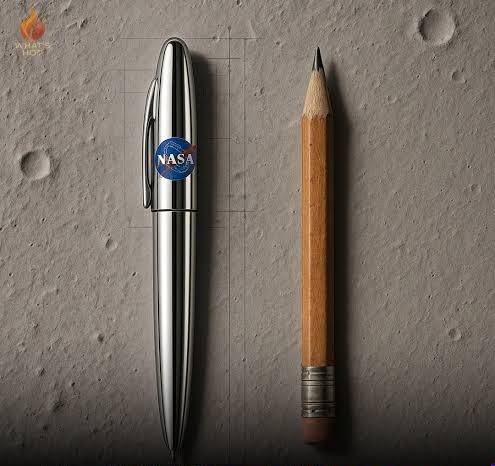
You have probably heard the story. “You can’t write with an ordinary pen in space, so NASA spent millions of dollars developing a pen that writes upside down. And the Russians? They used a pencil!” It is a great joke, and it keeps turning up on Facebook, WhatsApp and in motivational talks. The problem is that it is not true. The real story is more interesting.
What is the myth?
Some versions even give a price. A Facebook post that spread in 2019 claimed NASA spent more than $165 million over ten years. The fact-checking site PolitiFact rated it false: neither NASA nor the US Congress paid to develop the space pen.
Both sides actually used pencils
In the early years, American astronauts and Soviet cosmonauts both used pencils. The Smithsonian’s National Air and Space Museum still holds the pencil, tied on with nylon cord, and knee pad that John Glenn carried on Friendship 7 in February 1962. On Gemini missions, pencils were tethered to the cabin walls with retractable strings so they would not float away. Soviet cosmonauts used grease pencils.
In fact the public row at NASA was about pencils, not pens. In 1965 NASA bought 34 mechanical pencils from Tycam Engineering of Houston for $4,382.50, about $128.89 each. When the price came out there was an outcry, and NASA had to look for a cheaper option.
Why pencils were a hazard
A pencil is simple, but inside a spacecraft it is not that safe.
- Pencil tips break, and the fragments float around the cabin, where they could get into an astronaut’s eye or into sensitive equipment.
- The wood and graphite of a pencil can burn.
The second point became deadly serious after the Apollo 1 fire in January 1967, which killed three astronauts. In a pure-oxygen atmosphere even a small spark can start a big fire, so afterwards NASA checked everything carried aboard, even pens, very carefully.
Paul Fisher and his “anti-gravity” pen
In the 1950s American pen maker Paul C. Fisher was frustrated with ballpoints that leaked and skipped. He had already invented a universal refill that fitted most pens. Next he worked on a sealed cartridge pressurised with nitrogen gas, which pushes a piston against the ink so the pen does not depend on gravity and writes even upside down.
At first the pressure made the ink leak. The fix was to add resin to make the ink thixotropic: almost solid at rest, but turning liquid from the friction of the tiny rolling ball in the tip. Fisher called the pen the AG7, for “anti-gravity”, and patented it in 1965. His company reportedly spent about $1 million of its own money on the work. NASA became involved only after the pen existed.
NASA’s Manned Spacecraft Center (now Johnson Space Center) tested the pens thoroughly. They worked in every orientation, in extreme heat and cold, and in atmospheres from pure oxygen to vacuum. NASA wanted a pen that could draw a line about 0.5 km long; the pen drew more than 4.8 km.
How much did a pen cost?
After testing, NASA bought 400 Fisher pens for the Apollo programme. Sources differ slightly on the price: some say $6 each, others $2.39 after a 40% bulk discount. Either way it was a few dollars, not millions, and far cheaper than the $128.89 mechanical pencils.
On Apollo 7 in October 1968, commander Walter Schirra blew on a pen during a live TV broadcast to show it floating. From then on the pens flew on every NASA crewed mission. Fisher named his product the “Space Pen” only after it had flown in space.
The Soviets bought it too
The “Russian pencil” punchline is the funniest part. In 1969 the Soviet Union bought 100 Fisher pens and 1,000 ink cartridges for its Soyuz flights, at the same bulk discount NASA had received. Cosmonauts have used the pens since 1969. The two Cold War rivals ended up choosing the same pen.
The day a pen helped a mission
Apollo astronauts also carried felt-tip pens from the Duro Space Company. On Apollo 11 in 1969, a circuit breaker needed for lift-off from the Moon had broken, and Buzz Aldrin pushed it in with a felt-tip pen. We tell that story in a separate article.
The Space Pen today
Dozens of space pens are aboard the International Space Station today. In 2021 the Space Foundation inducted the technology into its Space Technology Hall of Fame. Fisher still makes more than a million pens a year in Boulder City, Nevada, and you can buy one online from Sri Lanka. Its users include not only astronauts but also soldiers, police, outdoor enthusiasts and oil workers.
The lesson
People who tell the “NASA pen, Russian pencil” joke mean that the simple solution is best. That is a fair idea, but this is the wrong example: a pencil is simple, but it is not safe in space. The true story teaches something better. A private company solved a problem with its own money, NASA tested the result and bought it at a fair price, and in the end both rival nations used the same pen. Next time the joke turns up on WhatsApp, you will know the real story.
Sources
- Scientific American – Fact or Fiction?: NASA Spent Millions to Develop a Pen that Would Write in Space (2006)
- Smithsonian National Air and Space Museum – The Saga of Writing in Space (2017)
- NASA Spinoff – How NASA Astronauts Write in Space
- PolitiFact – No, NASA did not spend over $165 million on a space pen (2019)
- Nautilus: The Challenges of Writing in Space
Spotted a mistake in this article?