In this article
On 11 November 1999, a NASA spacecraft far out in deep space suddenly lost the means to tell which way it was facing. It had been doing that by watching the stars, and the star tracker that did the job stopped working. There was no backup. Engineers thought the mission was over. Yet seven months later they radioed new software from Earth that gave the spacecraft a new “eye”. This is the story of Deep Space 1.
A spacecraft built to test new technology
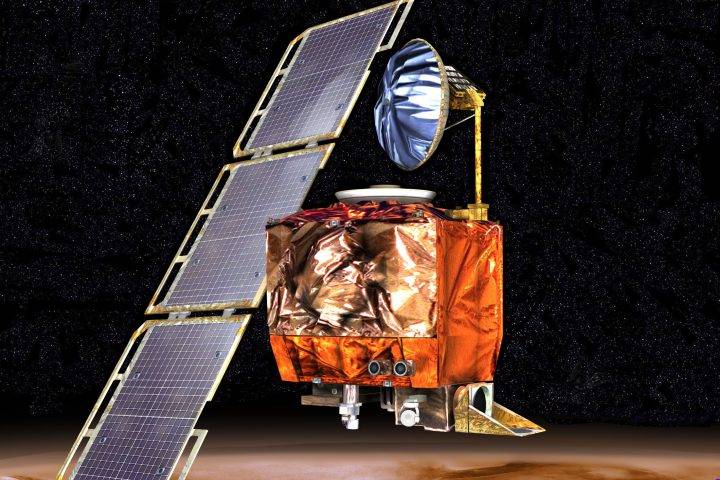
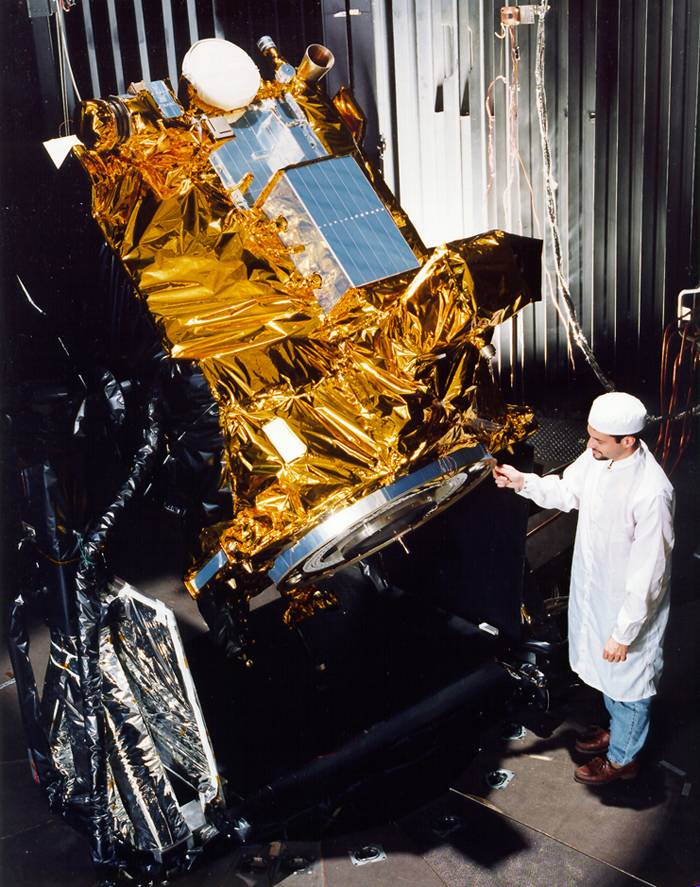
Deep Space 1 (DS1) launched from Cape Canaveral on a Delta II rocket on 24 October 1998. It was not an ordinary science mission. Its purpose was to test 12 new technologies in real space conditions, so that future missions could rely on them. DS1 would take the risk so later spacecraft would not have to.
The headline technology was the xenon ion engine: DS1 was the first interplanetary mission to test one, and it paved the way for Dawn and Psyche. But this article is about a less-told part of the story: the spacecraft’s “brain”, and how it was rescued.
A spacecraft that made its own decisions
DS1 carried software called AutoNav. It photographed asteroids and stars, worked out where the spacecraft was, and adjusted its course with the ion engine, all without engineers stepping in. Parts of AutoNav were later used by Stardust and Deep Impact.
Even more striking was Remote Agent, an artificial intelligence (AI) program. Given only goals, it was designed to plan how to reach them and to detect and fix problems on its own. On 17 May 1999 Remote Agent took control of the spacecraft. Engineers tested it with four simulated failures:
- a camera stuck on
- an electronics unit that appeared to fail
- a sensor fault
- a thruster stuck off
Remote Agent handled them all. But about 24 hours in, a real bug appeared: it switched the ion engine on and failed to switch it off. The cause was a timing error when two parts of the program exchanged information. The program had run about 3,000 times on Earth without the bug ever showing. Engineers understood the problem, and on 21 May they let Remote Agent make a new plan and fly the spacecraft on its own for six more hours. In the end the experiment met all its objectives.
Braille: a disappointing encounter
On 29 July 1999 DS1 flew past asteroid 9969 Braille. The plan was to pass about 240 m away, but it actually went by at about 26 km, at 15.5 km per second. A software problem the day before had put the spacecraft into safe mode, and the pictures were blurry. Still, the flyby proved an ion-propelled craft could reach a distant target. The primary mission ended on 18 September 1999, and the extended mission set its sights on comet Borrelly.
The day the star tracker stopped
On 11 November 1999 the Stellar Reference Unit (SRU), DS1’s star tracker, stopped sending data to the flight computer. It had shown intermittent problems since shortly after launch, and the failure was never fully explained. The spacecraft power-cycled it twice without success, then went into safe mode, pointed at the Sun.
Because of budget limits there was no second star tracker, and losing the SRU had been considered mission-ending. The ion engine had last been used in October 1999. It would not thrust again for more than seven months.
A rescue from Earth
Engineers tackled the problem in two phases.
- Pointing the antenna at Earth: Using only gyroscopes and the Sun sensor, they made the spacecraft slowly cone around the Sun direction. By watching signal strength on Deep Space Network antennas, they found the moment the main antenna faced Earth. This first worked on 14 January 2000, but it could not point the spacecraft in any other direction.
- Turning a camera into a star tracker: They wrote new software to use MICAS, DS1’s science camera, as a star tracker. The camera sees a far smaller patch of sky than the SRU did, about 0.7 degrees against 8.8 degrees, so the software was built to lock on to a single bright star, whose brightness and position were sent up from Earth.
Writing the software took about four months. Uploading began on 30 May 2000, the computer rebooted with it on 8 June, and the first star lock was attempted on 12 June. On 28 June the ion engine began pushing DS1 towards Borrelly again, about a week ahead of schedule.
Borrelly: the best comet pictures of their time
On 22 September 2001 DS1 passed about 2,200 km from the nucleus of comet 19P/Borrelly at 16.6 km per second. In Sri Lanka it was around 4 a.m. on 23 September. By then the hydrazine used to turn the spacecraft was running low, and engineers had rationed it carefully. The result was the best images of a comet nucleus obtained up to that time.
Farewell and legacy
On 18 December 2001 engineers sent DS1 its final command, the 9,905th transmission to the spacecraft, which turned off its transmitter. Its ion engine had run for 16,265 hours, longer than any spacecraft engine before it, and it had used about 90% of its xenon.
- DS1’s ion engine experience helped Dawn and Psyche.
- Parts of AutoNav flew on Stardust and Deep Impact.
- Parts of Remote Agent later supported Mars rovers and the Phoenix lander.
- DS1’s Small Deep Space Transponder was used on Dawn, Kepler, Spitzer and OSIRIS-REx.
But DS1’s biggest lesson is not any one technology. Even a spacecraft written off as finished, millions of kilometres away, can be brought back to work from Earth with a good idea and patience.
Sources
- NASA JPL – Deep Space 1 (DS1) mission page
- NASA History – 25 Years Ago: Launch of Deep Space 1
- NASA Science – 10 Things: Looking Back at Deep Space 1
- NASA JPL – Remote Agent Experiment Meets All Objectives (1999)
- Rayman et al. – Deep Space 1 Extended Mission (JPL paper)
- NASA NAIF/PDS – DS1 SPICE mission description
- Marc Rayman – DS1 Mission Log, 18 December 2001
Spotted a mistake in this article?